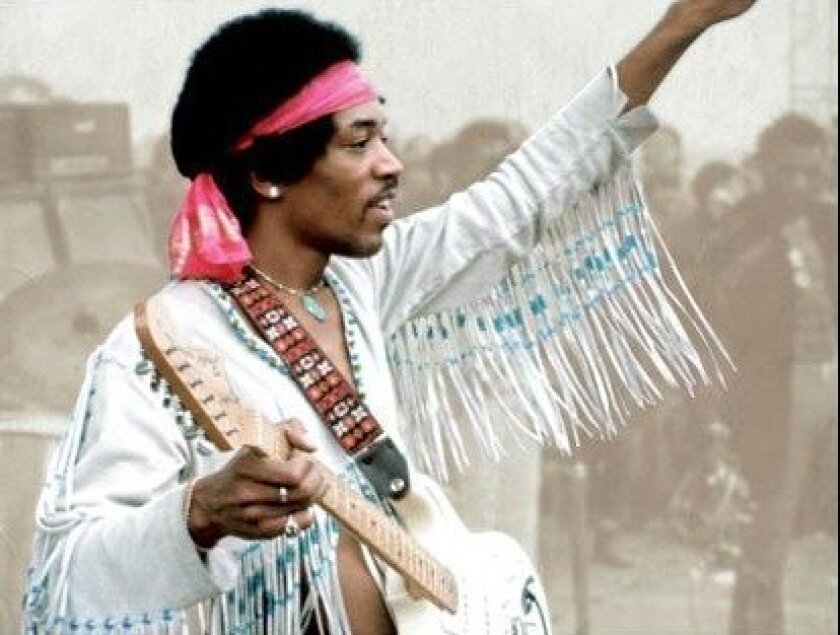
This week in class we read "Because My Father Always Said He Was The Only Indian Who Saw Jimi Hendrix Play 'The Star-Spangled Banner' At Woodstock" by Sheman Alexie. A theme in this chapter was the discrimination against minorities. Since Victor and his father are Native American they feel as though they are alone and treated wrongly. Victor's father goes as far as "beat[ing] the shit out of the National Guard private lying prone on the ground" (Alexie 25). His father goes to jail but comes back and there is a lot of tension between Victor's father and mother. This tension relates to the motif of war and peace in the story. Although there is a lot of fighting with words and disagreements, Victor thinks it is all okay because he heard them making love. Although these two don't always correlate, it was a little added humor for the story. To go along with this humor, there was sarcasm to make the serious anecdotes more lighthearted. An example of this is when Victor's mother is talking about her and Victor's father's divorce saying, "This might be the only marriage broken up by a dead guitar player," (Alexie 34). This remark makes the event seem as though it's not that important even though it's her own divorce. Talking about Jimi Hendrix and the effect it had on Victor's father shows the extent of power that music can have on someone. Victor said that "Music turned my father into a reservation philosopher. Music had powerful medicine" (Alexie 29). This shows how much music impacted Victor and his father's life. Victor's father let Hendrix take over his life. Victor's father overthought the impact of Jimi Hendrix making his experience with him more personal than it was. He says he was the "only Indian" and that him and Hendrix were "drinking buddies" (Alexie). Victor's father started to idolize and worship Jimi Hendrix and that's when it ruined Victor's family.
This week in class we read a piece called Show and Tell by Scott McCloud. This piece showed (and told) the importance of pictures in readings. It started off with a short anecdote of this kid in front of his class explaining how his robot toy transforms into an airplane. He uses a mixture of words and plain showing how it does what it does. This develops the author's main argument that "words and pictures have great powers to tell stories when creators fully exploit them both," (McCloud 809). I believe that images in books don't make a work of literature any less intellectual. If the content is meant to be intellectual, pictures aren't going to make it any less. Actually, images bring a different dynamic and can allow for more intellectual content. If an author were to include a statement where there could be many interpretations, that would be considered intellectual, but if you add an image to that and turn it into a comic, there could be an infinite amount of i...
Comments
Post a Comment